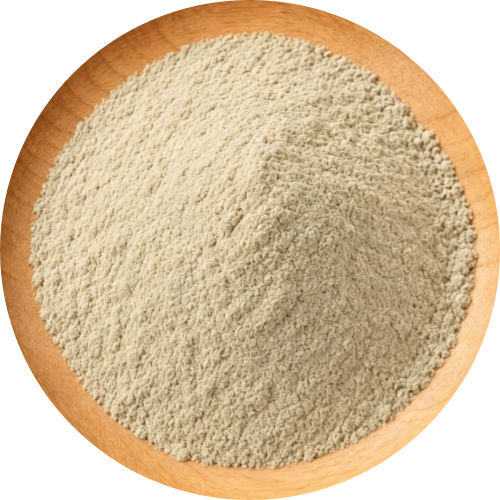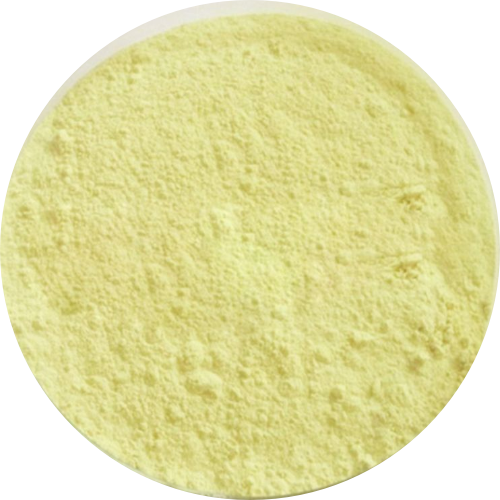
Vitamin K2 (MK-7) Powder is a menaquinone-7 ingredient supplied as a fine, free-flowing powder that ranges from off-white to light yellow depending on grade. It is a fully water-soluble vitamin K2 MK-7 powder, which is the detail that separates it from the oil-dispersed MK-7 most formulators are used to handling. There is no carrier oil in it, so it goes straight into aqueous systems.
The fermentation-derived vitamin K2 MK-7 is produced with Bacillus subtilis natto rather than through a synthetic route, and that is the origin that appears on the specification and on your label. Potency is confirmed on the finished powder by HPLC, so the figure your quality team reads is a measurement rather than a calculation from input materials.
Potency is offered across a wide band instead of a single fixed grade, so the powder can be matched to the dose per serving and to the capsule, tablet or gummy weight the product allows. Higher-content grades read more yellow; lower-content grades stay closer to off-white.
OEM and private-label work is routine here. We build for Vitamin K2 MK7 powder manufacturers and brand owners who need the grade set to their own label claim, as well as for contract manufacturers running private-label bone, heart and healthy-aging ranges. A trial quantity can be ordered before a production commitment.
Most buyers arrive because an oil-based MK-7 will not work in their next format - a clear drink, a stick pack, a gummy or a high-moisture matrix. Brands that already buy their D and E lines from vegan vitamin oil manufacturers use this powder to keep the same animal-free position across the K2 addition.
Plate count and moulds. Total plate count is held to ≤1,000 CFU/g and yeast and mould to ≤25 CFU/g, both measured to EP/USP methods on every lot rather than on periodic spot checks. Pathogen screening. Three screens - E. coli, Salmonella and Staphylococcus - have to return negative before a batch is released, and all three read not detected in routine testing. Heavy metals. Results are reported against the EP/USP limits printed in the specification table and come back not detected, which is the outcome QC labs look for when they audit a K2 line. Aflatoxin. Screening for B1, B2, G1 and G2 sits inside the release panel rather than being a service you have to request separately. Assay on the finished powder. Potency is confirmed by HPLC after drying, so the released result describes the bulk vitamin K2 MK-7 powder that actually leaves the warehouse, not what went into the fermenter. Traceability. Batches are third-party tested and traceable from the fermentation stage through to final packaging. When your QA team asks for the trail behind a lot number, it exists and travels with the shipment.
|
Product Name |
Vitamin K2 Powder |
|
Origin |
Bacillus subtilis Natto |
|
Shelf Life |
Two years when properly stored |
The band runs from 2,000 ppm to 15,000 ppm of menaquinone-7, confirmed by HPLC at each step. Moving up the range concentrates the active, which means a smaller powder weight carries the same dose in a capsule, tablet or gummy.
Colour moves with content. The higher the MK-7 figure, the more yellow the powder reads; the lower grades stay near off-white. That shift comes from the active itself rather than from a carrier or coating, so it is worth fixing the grade before you run a colour-sensitive trial.
Grade choice usually comes down to the space your dosage form gives you. A small capsule, or a gummy already carrying several actives, will want a higher-content grade to keep the inclusion weight down. A stick pack or a tablet with room to spare can use a lower grade and a larger inclusion of the water-soluble vitamin K2 MK-7 powder.
Work backwards from the label claim. Decide the MK-7 dose you want per serving, choose the grade that reaches it at a powder weight your line can handle, and let any overage your stability data requires sit on top. If your label declares IU rather than ppm, ask for the conversion basis we use so the two figures agree on the pack.
Keep one grade across a product family. Switching between grades between runs changes the assay as well as the shade, and re-qualifying a label claim is more work than settling the grade before the first production batch.
|
Items Specifications |
Methods of Analysis |
Results |
|
|
Descriptions |
|
|
|
|
Appearance Off-white to light yellow Powder; odorless |
Visual |
Conforms |
|
|
Physical & Chemical Tests |
|
|
|
|
Vitamin K2 (Menaquinone-7) |
≥2,000 ppm |
HPLC |
2,043ppm |
|
Lost of Drying ≤5.0% |
EP/USP |
1.46% |
|
|
Ash ≤3.0% |
EP/USP |
0.43% |
|
|
Lead (Pb) ≤0. 1mg/kg |
EP/USP |
N.D |
|
|
Arsenic (As) ≤0. 1mg/kg |
EP/USP |
N.D |
|
|
Mercury (Hg) ≤0.05mg/kg |
EP/USP |
N.D |
|
|
Cadmium (Cd) ≤0. 1mg/kg |
EP/USP |
N.D |
|
|
Aflatoxin (B1+B2+G1+G2) |
≤5μg/kg |
EP/USP |
<5μg/kg |
|
Microbiological Tests |
|
|
|
|
Total Plate Count ≤1000CFU/g |
EP/USP |
<10CFU/g |
|
|
Yeast & Mold ≤25CFU/g |
EP/USP |
<10CFU/g |
|
|
E.Coli. Negative |
EP/USP |
N.D |
|
|
Salmonella Negative |
EP/USP |
N.D |
|
|
Staphylococcus Negative |
EP/USP |
N.D |
|
Choosing the right grade should not be guesswork. Our Xi'an-based team works with our supplier partners to help you match specification, purity and delivery form to your formulation, and we answer technical questions on assay methods, documentation and storage before you commit to a batch. If something behaves unexpectedly in your process, we follow it up with the supplying manufacturer, share batch records and COA data, and suggest a practical adjustment. Most enquiries are answered within one to two business days, and samples go out with the paperwork you need to assess them properly.
The MK-7 is produced by fermentation with Bacillus subtilis natto and is supplied from 2,000 ppm up to 15,000 ppm, with the content confirmed by HPLC on every batch. Purity is controlled to EP/USP methods across assay, moisture, ash, heavy metals, aflatoxin and microbiological limits, and a lot is released only when every one of those results sits inside specification.
Yes on both counts. No animal-derived inputs are used, and the powder is fully water-soluble, so it dissolves into aqueous systems instead of needing an oil phase. Brands that have been buying their other fat-soluble vitamins from vegan vitamin oil manufacturers can keep the same claim across the K2 line - ask for the vegan statement so you can check its wording and scope against your market before anything is printed.
The MK-7 content can be set within the fermentation-derived band we run, which is how Vitamin K2 MK7 powder manufacturers and brand owners get a grade matched to their label claim rather than to a catalogue number. Carrier and blend changes depend on the dosage form and are agreed case by case. The assay and contaminant methods stay fixed, so the documentation means the same thing from lot to lot.
Vitamin D3 and calcium are the usual companions, and K2 is routinely formulated alongside both in bone-health products. For the vitamin E side, the tocotrienol lines we coordinate with palm tocotrienols manufacturers are supplied as separate ingredients, so each nutrient can be dosed and declared on its own. Send the full formula and we will confirm what the K2 grade needs to look like in that blend.
It is a fine, free-flowing powder that hydrates into the gummy mass without an oil phase, and it brings almost no taste or smell of its own, so a masking flavour is usually unnecessary. Colour contribution rises with MK-7 content, so a high-content grade can shift the finished shade slightly - run the grade you intend to buy in a pilot batch before the shade is set.
Confirm the grade and its colour against your own trial, ask for the particle size distribution and carrier details if you are blending, and check that the release testing uses the methods your QC lab runs. If the same project also covers vitamin E, ask at the same time about the vitamin E lines we source with rice tocotrienols manufacturers, so specifications and shipping windows are agreed together rather than in sequence.