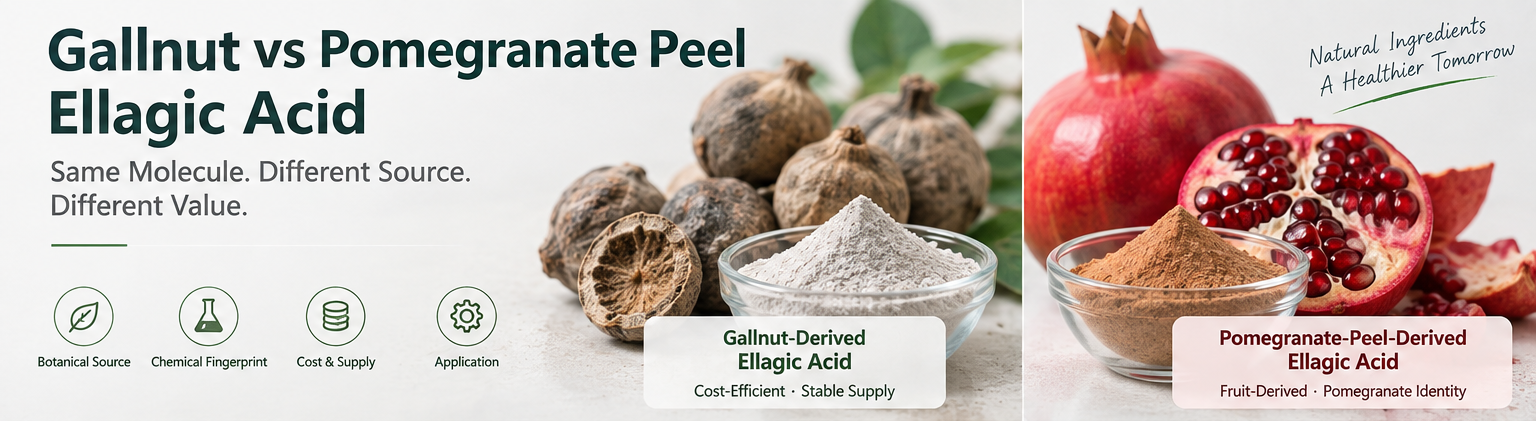
Ellagic Acid is commercially available from more than one botanical source. Two of the most important routes are gallnut-derived Ellagic Acid and pomegranate-peel-derived Ellagic Acid.
Both can be standardized to the same HPLC assay—40%, 90% or even higher—and the target molecule remains Ellagic Acid. However, this does not make the two ingredients commercially interchangeable.
The real difference lies upstream of the active molecule: botanical origin, accompanying chemical profile, source traceability, cost structure and suitability for the intended product.
This distinction matters particularly in the dietary supplement market, where a low-cost gallnut-derived material should not be represented or substituted as pomegranate-derived Ellagic Acid simply because both meet the same Ellagic Acid assay.
Gallnuts are tannin-rich plant galls formed through interactions between insects and host plants. Their high tannin content makes them an efficient industrial starting material for producing concentrated Ellagic Acid through hydrolysis and subsequent purification.
Commercial grades commonly include:
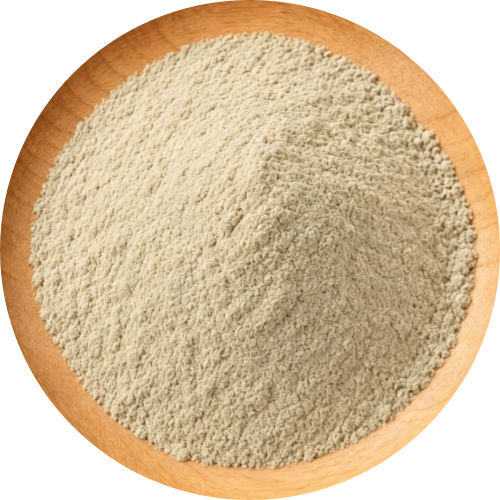
The material is typically gray-white to light gray, depending on purity and processing.
Its primary commercial advantage is economics. Established production capacity and abundant tannin feedstock allow gallnut-derived Ellagic Acid to be supplied at comparatively low cost and with relatively stable availability.
For applications where the buyer primarily requires the Ellagic Acid molecule and has no specific fruit-source requirement, this can be an efficient sourcing route.
Pomegranate peel follows a different chemical pathway.
Rather than simply being a tannin-rich industrial feedstock, pomegranate peel naturally contains a characteristic polyphenol system composed of Ellagitannins, Punicalagins, Ellagic Acid and related compounds.
Commercial products therefore fall into two broad categories.
One is Ellagic Acid-standardized Pomegranate Peel Extract, commonly available at 40%, 90%, 95% and 98% Ellagic Acid.
The other retains more of the original pomegranate polyphenol profile and may instead be standardized to total pomegranate polyphenols, Ellagitannins and/or Punicalagins.
This gives pomegranate peel a different commercial value: it provides not only Ellagic Acid, but also a traceable fruit-derived botanical identity that can support pomegranate-focused nutraceutical formulations.
This is the most important point when comparing the two sources.
If purified from either source, the target Ellagic Acid molecule is chemically the same.
The major difference is therefore not:
Gallnut Ellagic Acid vs Pomegranate Ellagic Acid as two different active molecules.
It is:
Those matrices can carry different accompanying compounds and source-specific chemical fingerprints.
This explains why two raw materials can both pass an Ellagic Acid ≥40% HPLC assay while still being different ingredients from a sourcing and identity perspective.
An Ellagic Acid assay answers:
How much Ellagic Acid is present?
It does not necessarily answer:
Where did that Ellagic Acid come from?
For professional botanical ingredient sourcing, these are two separate questions.
The difference in botanical origin can be analytically relevant.
A 2024 study comparing Ellagic Acid extracts derived from pomegranate peel and gallnuts used UHPLC-ESI-HR-MS to investigate their chemical profiles. The researchers identified anacardic acid and ginkgolic acid C15:1 in gallnut-derived crude extracts and proposed these compounds as useful markers for distinguishing botanical origin.
Pomegranate-derived material, meanwhile, originates from a polyphenol system naturally associated with Punicalagins and other Ellagitannins.
This creates an important distinction between two types of testing:
Assay Testing → verifies Ellagic Acid concentration
Fingerprint / Source Testing → helps verify botanical identity
For a buyer specifically purchasing Pomegranate Peel Extract 40% Ellagic Acid, passing the 40% HPLC assay alone therefore does not fully establish that the material is actually derived from pomegranate peel.
That distinction is especially important where the botanical source forms part of the customer's ingredient specification.
The issue should not be reduced to the claim that gallnut-derived Ellagic Acid is universally “prohibited” in Europe or the United States.
For many supplement brands, the concern is more practical and relates to ingredient identity, impurity control, labeling and supplier qualification.
Gallnut is a plant gall rather than a fruit-derived raw material.
Pomegranate peel, by contrast, comes directly from the fruit of Punica granatum.
For a finished product positioned around pomegranate, fruit-derived polyphenols or pomegranate botanical actives, gallnut-derived Ellagic Acid cannot provide the same botanical-source identity.
Gallnut-derived crude Ellagic Acid extracts can contain source-associated compounds that differ from the pomegranate profile. This may lead quality teams to request additional fingerprint or impurity testing rather than relying solely on Ellagic Acid assay.
If a finished supplement is formulated and marketed using Pomegranate Extract or Pomegranate-Derived Ellagic Acid, its supply-chain documentation needs to support that declared source.
A gallnut-derived material should therefore not be substituted for pomegranate-derived material without customer approval simply because the Ellagic Acid assay is identical.
This becomes particularly relevant because gallnut-derived Ellagic Acid is generally less expensive.
The price gap creates an obvious sourcing risk: a lower-cost gallnut-derived ingredient may potentially be offered as a higher-value pomegranate-derived material.
For serious supplement brands, this turns source verification into an ingredient authenticity and supply-chain transparency issue, rather than simply a debate over which plant produces better Ellagic Acid.
The consequences can be summarized clearly.
| Factor | Gallnut-Derived Ellagic Acid | Pomegranate-Peel-Derived Ellagic Acid |
|---|---|---|
| Starting Material | Tannin-rich plant gall | Pomegranate fruit peel |
| Target Molecule | Ellagic Acid | Ellagic Acid |
| Common Assays | 40%, 90%, 98% | 40%, 90%, 95%, 98% |
| Typical Appearance | Gray-white to light gray | Yellow-brown to reddish-brown |
| Chemical Background | Gallnut tannin-derived profile | Pomegranate Ellagitannin/Punicalagin-related profile |
| Source Verification | Gallnut-associated markers can support identification | Pomegranate polyphenol fingerprint can support identity |
| Cost | Generally lower | Generally higher |
| Supply | Relatively stable | More dependent on pomegranate raw-material supply and processing |
| Fruit-Derived Positioning | No | Yes |
| Typical Commercial Fit | Cost-sensitive applications where gallnut origin is acceptable | Pomegranate-positioned nutraceutical and botanical formulations |
The result is simple:
It can influence supplier qualification, botanical declaration, impurity assessment, formulation positioning and whether the ingredient matches the customer's original specification.
When discussing Ellagic Acid itself, the distinction becomes smaller.
The active Ellagic Acid molecule does not acquire a different identity simply because it originated from gallnut or pomegranate peel.
Ellagic Acid itself is a polyphenolic compound with antioxidant activity. It can also enter another biologically important pathway involving the gut microbiome.
Ellagitannins can be hydrolyzed to release Ellagic Acid, after which intestinal microorganisms can further metabolize Ellagic Acid into urolithins, including Urolithin A.
The simplified pathway is:
Ellagitannins → Ellagic Acid → Gut Microbiota → Urolithins
However, Urolithin A production is highly dependent on the individual's intestinal microbiota. Different people possess different urolithin metabotypes, meaning the ability to convert Ellagic Acid precursors into Urolithin A can vary substantially.
Therefore:
And:
When the target molecule is Ellagic Acid, the major differences between gallnut and pomegranate sources occur primarily before consumption—in source identity, accompanying compounds, traceability, quality control and commercial positioning.
This is another important distinction for formulators.
Not every pomegranate ingredient needs to be highly purified into Ellagic Acid.
Depending on the finished product concept, manufacturers can choose among different pomegranate active profiles.
For formulas specifically targeting Ellagic Acid:
Pomegranate Peel Extract ≥40% Ellagic Acid
Higher-purity grades such as 90%, 95% or 98% may also be selected where a more concentrated Ellagic Acid input is required.
For formulas where Punicalagins are the primary marker:
Pomegranate Extract ≥40% Punicalagins
This retains a very different active profile from an Ellagic Acid-standardized extract.
For formulations designed around a broader pomegranate polyphenol profile:
Ellagitannins ≥70% + Punicalagins 30%
These specifications should not be viewed as different purity levels of the same ingredient.
They represent different formulation strategies.
The correct source depends on the finished product rather than the Ellagic Acid percentage alone.
Consider gallnut-derived Ellagic Acid when:
Its primary advantage is cost-efficient access to concentrated Ellagic Acid.
Consider pomegranate-peel-derived Ellagic Acid when:
Here, paying more for pomegranate source is not simply paying more for the same molecule.
The buyer is also purchasing source identity and alignment with the finished-product positioning.
Consider a Punicalagins/Ellagitannins-standardized extract when the objective is to formulate around the wider pomegranate polyphenol system rather than isolated Ellagic Acid.
This is particularly relevant when the customer wants the formulation to remain closer to the characteristic active profile of pomegranate peel.
If the real formulation objective is Urolithin A itself, relying on Ellagic Acid introduces an unavoidable variable: individual gut microbiota.
Direct Urolithin A therefore represents a separate formulation strategy for projects seeking to avoid dependence on individual conversion capacity. Its regulatory status, manufacturing route and target-market requirements should be assessed independently from conventional pomegranate extracts.
The largest commercial risk in this category is not that gallnut-derived Ellagic Acid exists.
It is source substitution without disclosure.
If a customer orders:
Pomegranate Peel Extract — Ellagic Acid 40%
supplying:
Gallnut Extract — Ellagic Acid 40%
is not an equivalent substitution simply because both materials pass the same HPLC Ellagic Acid specification.
The molecule may be the same, but the declared botanical ingredient is not.
For pomegranate-derived Ellagic Acid procurement, buyers should therefore verify:
A particularly low quotation for Pomegranate-Derived Ellagic Acid is not evidence of substitution, but it is a reasonable reason to investigate the source more carefully.
The difference between gallnut-derived and pomegranate-peel-derived Ellagic Acid becomes much easier to understand once the active molecule is separated from the raw-material source.
At the molecular level:
Both routes can provide Ellagic Acid, and both depend on individual gut microbiota if the intended downstream pathway involves conversion to Urolithin A.
At the ingredient level:
They differ in botanical origin, accompanying chemical profile, source markers, appearance and traceability.
At the commercial level:
Gallnut generally provides the lower-cost route, while pomegranate peel provides fruit-derived identity and closer alignment with pomegranate-positioned nutraceutical products.
At the procurement level:
The two sources should not be substituted without disclosure and customer approval simply because their HPLC Ellagic Acid assays are the same.
For buyers, the right selection sequence is therefore:
Finished Product → Required Botanical Source → Target Active Profile → Source Verification → Assay → Cost
—not price first, source later.
KEEP INGREDIENTS offers different pomegranate active profiles for different formulation strategies, including Pomegranate Peel Extract standardized to Ellagic Acid, high-Punicalagins Pomegranate Extract, and Ellagitannins/Punicalagins standardized extracts.
For a new project, provide your target active, finished dosage form and destination market so the appropriate pomegranate specification can be evaluated before sampling and formulation testing.
Email: info@keepingredients.com
Website: KEEP INGREDIENTS