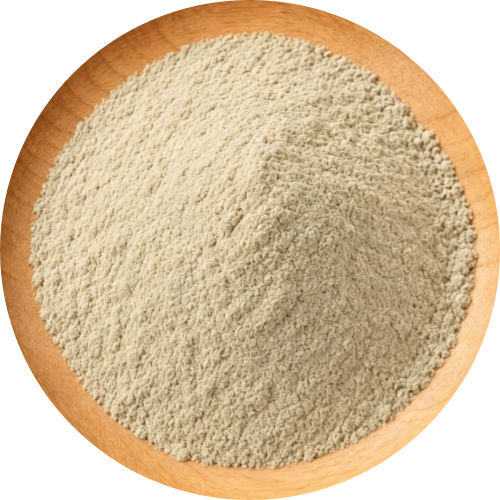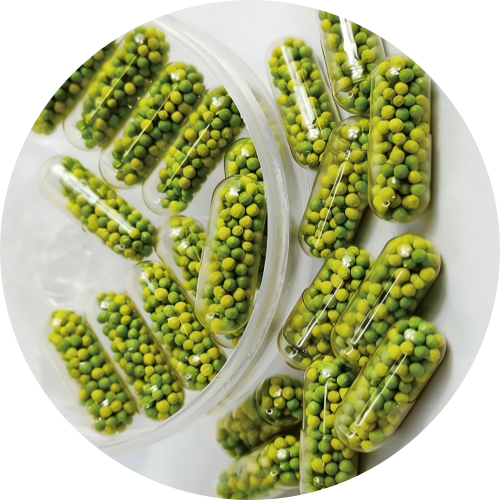
Micropellets are spherical to near-spherical particles between 0.1 mm and 2.5 mm in diameter, built as a multi-layer active-carrier system rather than a coated powder. Each pellet carries its own share of the active, so a single capsule holds thousands of independent release units. It is the format buyers ask micropellets manufacturers for when a brand wants sustained release without a tablet.
Sphere core. Every pellet starts on a sucrose, starch or cellulose core a few hundred micrometres across, and the core material is your choice. Its diameter fixes the finished size within the pellet size 0.1 mm to 2.5 mm band, and its roundness is what gives the granule the flow behaviour that later makes high-speed filling possible.
Active ingredient layer. The active is laid onto the core in a coating pan, in a quantity matched to the core mass, so payload per pellet is a defined figure rather than an average. Vitamins, minerals, botanical extracts and fermentation-derived compounds all pass through the same layering step, which is what lets us serve as a nutraceutical ingredients supplier across a whole product range.
Sustained-release layer. A polymer coating goes over the active — shellac or hydroxypropyl methylcellulose, depending on the curve you want — and this is the step that turns the pellet into sustained-release micropellets. It slows the release rate and holds a steadier level instead of letting the full dose arrive at once.
Protective outer layer. A natural or compound pigment seals the four-layer encapsulation. It reduces direct contact between irritant actives and the gastrointestinal lining, improves tolerance, and keeps the physical and chemical properties stable through storage and processing.
The format replaces two things at once: loose powders that dose unevenly and release in a rush, and tablets that many consumers struggle to swallow. Contract manufacturers, brand owners and liposomal supplement manufacturers come to us because one pellet platform covers capsules, sachets and stick packs without a separate process for every active.
Superior flowability. The regular spherical shape gives excellent flow, which is what makes high-speed capsule filling possible with minimal dosage variance from the first capsule to the last. Uniform content. Unit-to-unit variation stays small, so every capsule or sachet carries a precise and consistent amount of the active rather than a scatter around the label claim. Cleaner handling than powder. A dense, granular material dusts less and feeds more predictably through hoppers, dosators and packaging equipment, cutting cleaning downtime and product loss. Aesthetic appeal. Colour is an OEM variable, so the granule can carry a brand colour and give the finished capsule or stick pack a look consumers recognise on the shelf. Gastric protection. The outer layer limits direct contact between irritating actives and the stomach lining, which is what makes high-dose iron, magnesium and Vitamin C pellets tolerable for everyday use. Structural integrity. The four-layer architecture holds together under the mechanical stresses of blending, encapsulation and packing, so the release behaviour you validated in the trial batch survives the production run. Built for automated lines. Bulk micropellets run on automated encapsulation and packaging systems without the dosing drift and waste that fine powders cause on the same equipment. One platform, many actives. The same process takes vitamins, minerals, botanicals and fermentation-derived compounds, which shortens development when a brand extends its range.

Controlling where and when an active is released lets the body absorb more of it than it can from a conventional powder, where a large share may pass through before uptake. That is the practical difference bioavailability makes in a finished product, and it is the first thing formulators ask us to demonstrate. The result is a steadier nutrient level in the bloodstream rather than a peak followed by a rapid drop. Small particles are not held up by gastric emptying the way a single tablet is, so absorption stays consistent and person-to-person variability narrows. Teams building liposomal supplements alongside a pellet line recognise the same principle: control the carrier, and the dose behaves more predictably. Consumers who abandon high-dose powders because of stomach discomfort tend to stay on a pellet format, which shows up in repeat purchase rather than in the first order. Sensitive actives are protected inside the pellet as well. Layering and the dense particle body limit exposure to light and oxygen, so oxidation-prone ingredients hold their potency closer to the label for longer.
| Property | Value |
|---|---|
| Pellet size | 0.1 mm to 2.5 mm |
| Pellet shape | Spherical to near-spherical |
| Layer structure | Four-layer encapsulation: core, active ingredient layer, sustained-release layer, protective layer |
| Core material | Sucrose, starch or cellulose (micropellet OEM choice) |
| Sustained-release polymer | Shellac or hydroxypropyl methylcellulose (OEM choice) |
| Outer layer | Natural or compound pigment (OEM choice) |
| Release profile | Custom release-time curves for sustained-release micropellets |
| Active options | Vitamins, minerals, botanical extracts, fermentation-derived compounds |
| Dosage form fit | Capsules, sachets, stick packs, food mixes |
| Colour | Customisable for brand appearance |
| Facility certifications | ISO9001, ISO22000, HACCP, GMP, HALAL; FDA-registered facility |
| Related delivery formats | Liposomal supplements, co-loading liposomal, plant-derived exosome |
| Property | Value |
|---|---|
| Packaging | Industrial-grade sealed packaging for bulk micropellets |
| Storage conditions | Cool, dry place, out of direct sunlight |
| Moisture and air exposure | Dense pellet body limits ingress compared with fine powders |
| Handling after opening | Reseal promptly and use clean, dry scoops |
| Caking and dusting | Low, because the pellets are dense and free-flowing |
| Transit protection | Packed to hold product integrity through international freight |
| Shelf stability | Pellet form keeps its shape and flow through normal warehouse storage |
Choosing the right grade should not be guesswork, particularly on a micropellet OEM brief. Our Xi'an-based team works with our supplier partners to help you match specification, purity and delivery form to your formulation, and we answer technical questions on assay methods, documentation and storage before you commit to a batch. If something behaves unexpectedly in your process, we follow it up with the supplying manufacturer, share batch records and COA data, and suggest a practical adjustment. Most enquiries are answered within one to two business days, and samples go out with the paperwork you need to assess them properly.
Vitamins, minerals and trace elements, botanical extracts and fermentation-derived compounds all run on the same platform. Vitamin C, iron, magnesium and zinc are the most requested, alongside NMN, Coenzyme Q10, glutathione, curcumin and berberine. If your active is heat-sensitive or particularly irritating to the stomach, tell us at the brief stage — the layering and coating steps are adjusted around it.
Yes. Release-time curves, multi-ingredient layering and outer colours are all OEM variables. The four-layer build is adjusted one layer at a time — a thicker or different polymer shell for a slower curve, a different pigment for the colour — without rebuilding the pellet from scratch. Send the target release window and a colour reference with the brief.
Production runs in facilities certified to ISO9001, ISO22000, HACCP and GMP, with HALAL certification and FDA-registered facility status. Every batch is tested against the specification agreed for the project and released with its own certificate of analysis. Confirm the certificate holder and scope that apply to your specific grade before you file the documents in a dossier.
The band runs from 0.1 mm to 2.5 mm. The smaller end suits capsules and sachets where a smooth fill and an even dose matter; the larger end suits chewables, food mixes and any product where the granule should be visible. Size also affects how the pellet passes through the gut, so fix the band with your formulation team rather than by habit.
They are different delivery systems rather than substitutes. A pellet gives a solid dose with a controlled release; a liposomal system carries the active in a phospholipid structure, usually as a liquid or a powder. Many brands run both — a capsule or sachet built on micropellets next to a liposomal supplements line — and each format has its release logic planned separately.
Yes. The granules can be swallowed with water or stirred into soft food, which is why they are popular in pediatric and senior products. If the finished product will be a sachet or a stick pack, tell us at the brief stage so pellet size and coating are matched to the fill weight.
Two or more actives can be carried in one pellet or blended as separate pellets, and actives that should not meet in the same layer are separated into different pellets instead. Confirm the combination and the target ratio with our technical team before the specification is fixed.